

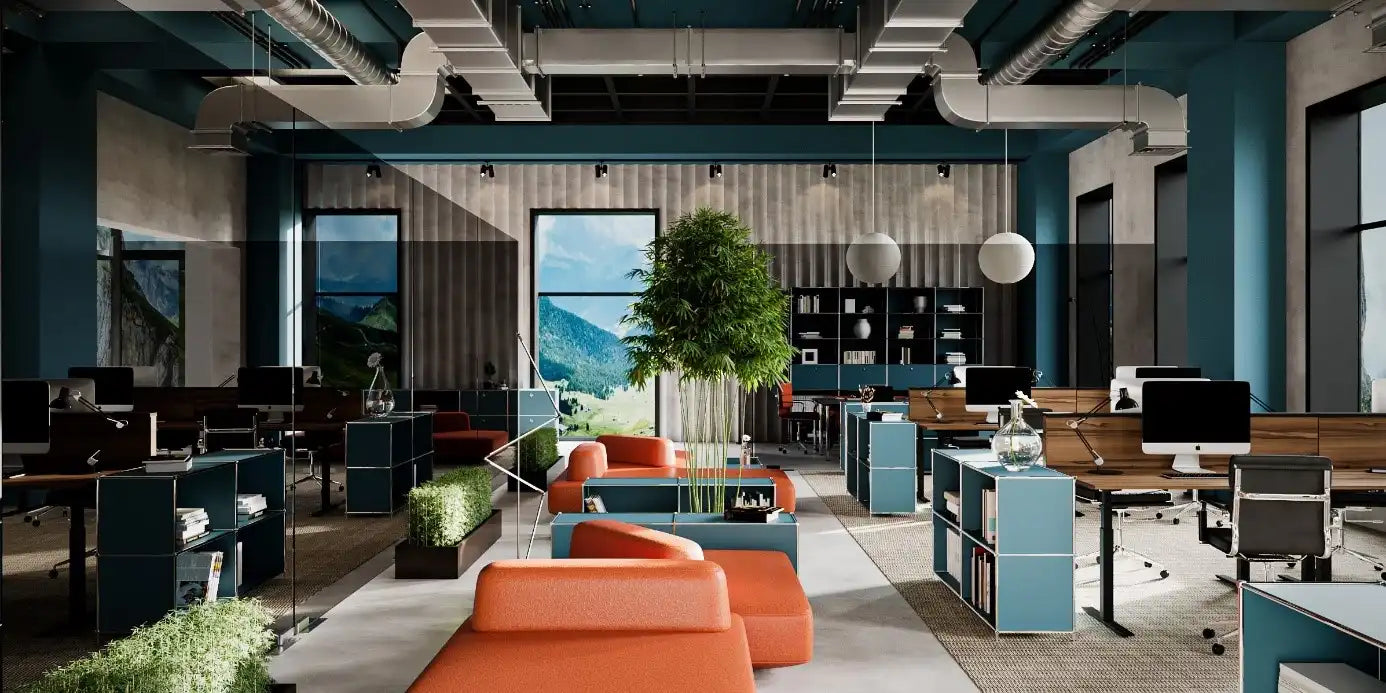
Modern office design is more than just a matter of aesthetics. It increases employee satisfaction and productivity. Competition for top talent is intensifying, skilled workers are becoming increasingly difficult to recruit, and expectations of employers are rising. Creating modern office spaces, utilizing cutting-edge technologies, and offering the option of working from home or even remotely can help attract and retain top talent.

The office of the future should be designed to foster collaboration and creativity, with plenty of open-plan workspaces, natural light, and innovative technologies. It should not only provide a pleasant and productive work environment but also be highly sustainable, featuring energy-efficient buildings and green spaces. As companies strive to stay ahead of the competition, the office of the future will become increasingly important. The requirements for optimal office design have changed dramatically in recent years due to new technologies and societal shifts. Many new trends are impacting the work environment. In this blog, we will explore some of the latest trends in office design and examine how they influence the workplace.
What does flexible office design mean?

What are the current trends? How do they influence the design of the work environment? Flexibility and adaptability are crucial for success, even in a challenging business environment. Office design is no exception. Flexible office design is therefore becoming increasingly important.
Advantages of Flexible Office Design
More and more companies are recognizing that rigid office design is outdated and that it's important to address the individual needs of their employees. Flexible office design includes the ability to adapt workspaces to employee needs. This can mean that employees have the option to work standing or sitting , that they have the opportunity to retreat to a quiet space to concentrate, or that they can work from home .
History and definition of flexible office design
The term “flexible office design” originated in the 1970s, when companies began to break down the rigid and hierarchical structures of their workplaces. Flexible office design refers to a work environment that can adapt to the changing needs of employees . This means that workspaces are designed to meet diverse requirements, whether through a variety of work areas or a forward-thinking selection of furniture and equipment.
Here's how to implement flexible office design in your office:
- Analyzing employee needs: Before you begin designing your office, you should meet with your employees to determine their needs and requirements. These needs depend heavily on the office concept they want to work in. The office concept answers the question of HOW work should be done: at individual workstations, in group offices, or in an open-plan office; at fixed workstations or desk-sharing workstations.
- Create a sufficient variety of workspaces to meet the diverse needs of employees or teams. Provide quiet spaces for focused, undisturbed work. Develop meeting areas and conference rooms to foster communication and collaboration without disturbing other colleagues.
- Opt for multifunctional furniture : Invest in furniture that is flexible and multifunctional to easily meet the needs of your employees and your company today and in the future.
Office design in the home office: How flexible workspaces make working from home easier
In times of remote work and home office, flexible office design is becoming increasingly important. It offers employees the opportunity to personalize their work environment and feel more productive in their familiar surroundings. At the same time, it presents employers with an opportunity to provide their employees with an optimal working environment. Flexible office design can also help employees better adapt their working hours to their needs, thus achieving a better work-life balance. Overall, a flexible office design for home offices can contribute to more productive and satisfied employees, thereby contributing to higher quality work.
Flexible office design for coworking spaces: The ideal working environment for modern employees and companies
Coworking spaces are an excellent example of flexible work environments. The ability to integrate different work styles is a major advantage for both employers and employees. Companies can give their employees the freedom to choose their work style and hours, while employees have the opportunity to work in an inspiring environment. The various workspaces in a coworking space allow employees to adapt their work style to their needs. Whether they want to work in the office, from home, or remotely, the coworking space offers a suitable work environment. The concept of a coworking space differs significantly from a traditional office, as it fosters contact and exchange between different companies. The diverse work locations and styles offer a wealth of information and contacts that can be valuable for both companies and their employees.
What influence does modern technology have on office work?

Over the past 10 years, the rapid development of modern technologies has fundamentally changed the way we work in the office. Here are some of the most significant changes that have occurred during this time:
- Mobile technology : The introduction of smartphones and the diverse possibilities of video conferencing enable users to be reachable anywhere and to ensure meetings are quick, easy and independent of the workplace.
- Cloud Computing: Cloud technology enables access to data and applications from anywhere.
- Social media platforms : Social media have become important communication channels for interacting with customers and employees.
- Artificial intelligence (AI) will also find its way into the office environment in increasingly diverse ways. It can contribute enormously to increasing productivity.
For office work and concept development, this means that not every employee is necessarily dependent on a fixed workstation in the office anymore. The option of working from home has become established in many companies. The concept of mobile working takes this a step further.
What does mobile working mean?
Mobile working goes beyond working from home . It refers to the ability to work from any location without being tied to a fixed workplace. It requires the use of modern technologies such as smartphones, laptops, and tablets to access work resources like emails, data, and applications. Mobile working allows employees to be more flexible and perform their work from various locations instead of being bound to a fixed workplace. This model is still relatively new but enjoys particular popularity among some younger generations. It allows employees a better work-life balance, and it can help companies attract new talent who would otherwise be difficult to recruit. Mobile working and working from home can also be advantageous for employers, as they can save costs by, for example, requiring less office space or using existing office space more efficiently and generously for the remaining core staff. It's worth considering whether the job content is suitable for these working arrangements and whether your employees are receptive to them.
How do you create a good workplace and room concept?

Once the question of how work should be carried out has been clarified ( office concept ), step 2 deals with the requirements for and the equipment of the individual workstations and areas ( workplace concept ), and step 3 with the spatial arrangement ( room concept ).
- The workplace concept defines the size and function required for each individual workstation . Different tasks often necessitate different requirements regarding technical equipment and furnishings. A sufficiently large desk , an ergonomically adjustable office chair , and storage space for work documents and personal belongings are the three most essential elements of a well-equipped workplace. Good lighting, ideally with natural light, is also crucial.
- Besides efficient individual work, an important aspect of office design is the opportunity for social interaction. It is important to create an environment that allows employees to interact with one another.
- Create shared spaces where your employees can meet and exchange ideas: a comfortable seating area and a coffee kitchen or kitchenette with small bistro tables or a long table for meetings.
- Team events and shared activities can also help strengthen team spirit within the company. This becomes even more important when employees work from home or remotely, or when many part-time employees only see each other relatively rarely.
In the spatial concept, you arrange the different functional areas within the space. A good spatial concept must consider the requirements for undisturbed work, communication opportunities, and social interaction. Take your floor plan and plan the individual areas. Then, take a virtual tour of your office space and check how well your wishes have been implemented.
- An inviting entrance/reception
- A good overview
- Disturbance-free working zones
- Sufficient distance between individual workstations
- Adequate sound insulation
- Sufficient proximity for teamwork
- Sufficient number and size of meeting and gathering areas
- Retreat spaces for focused work
- Ample storage space
- Efficient walking routes
Design and color for a pleasant working atmosphere and a professional appearance

The choice of office furniture influences the appearance and working atmosphere: design, function and quality are crucial!
The appearance and working atmosphere of your office are significantly influenced by your choice of office furniture. Design, function, color, and quality all play a role. Choose office furniture that meets the demands of your company. If possible, select furniture that is flexible, adaptable, and durable. This allows your furnishings to evolve with your business while maintaining a consistent and professional overall look. Traditional office furniture is usually strictly white or light gray. In some industries, black is the dominant color. New office designs today often feature a much bolder approach to color, creating spaces that convey a positive mood and energy, thus fostering a pleasant working environment.
Natural elements

A trend that has become increasingly prevalent in office design in recent years is the use of natural elements. Offices are increasingly being designed with plants and natural materials such as wood and stone. These natural elements create a pleasant atmosphere and help to reduce employee stress levels. They also improve air quality in the office and boost employee productivity.
Conclusion
Office design has changed dramatically in recent years. Many companies now prioritize creating a work environment that promotes employee productivity, health, and satisfaction, thereby boosting business success. Implementing good office design doesn't have to be difficult. We've summarized the most important aspects for you in this checklist.
- Needs analysis involving employees and customers
- Clarity about your office concept
- List of all areas that the office should include
- Creation of workplace concepts
- Creation of a spatial concept
- Selection of office furniture
- Design and decoration of your office spaces
If you would like Flexcube modular furniture for your office, we would be happy to create a non-binding and free office plan according to your wishes.
Share :
Setting up a law firm – what you should pay attention to
Reception counters – Modern, stylish and individual