

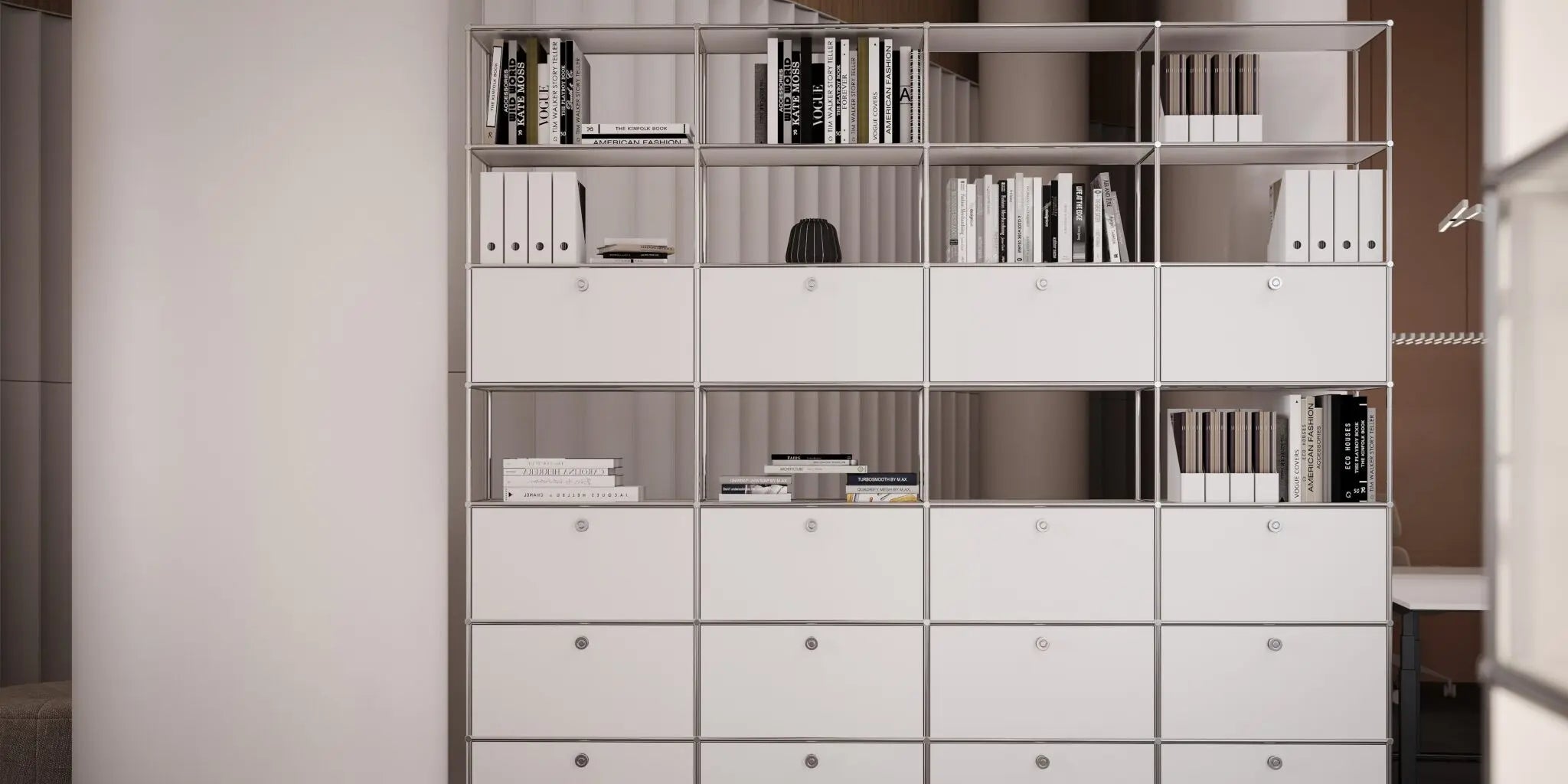
A shelf is not just storage space. A shelf organizes a room, divides areas, holds memories, and often needs to last for decades. Choosing a shelving system is one of the most important furnishing decisions one can make. This guide shows you what to look for when buying, what systems are available, which material suits which room, and how to configure a modular shelving system so that it grows with you.
What is a shelving system and how does it differ from a classic shelf?
A single shelf is a rigid piece of furniture with fixed dimensions. A shelving system, on the other hand, is a modular solution: you combine elements, depths, heights, and colors as needed, and you can later expand or reconfigure the system. A sideboard can become a floor-to-ceiling shelf with additional modules. A wall of books can become a freestanding wardrobe during a move.
This flexibility is the key advantage. A good shelving system is not a one-time purchase for a specific room, but an investment that spans multiple life stages.
Overview of the most important shelving system types
1. Modular metal shelving systems
Metal shelves made of stainless steel and powder-coated steel are the most durable category. They can bear heavy loads, do not absorb moisture, can be powder-coated in many colors, and can be used in any room – from the living room to the home office to the reception area in an office. Modular systems like Flexcube or USM Haller work on the same principle: a standardized grid that can be expanded as desired.
2. Solid wood shelves
Shelves made of oak, walnut, or ash have a warm and natural look. They suit classic interiors and age beautifully. Disadvantages: high weight, limited color selection, usually not modularly expandable. Repairs to visible areas are complex.
3. Wall shelves and floating boards
Wall-mounted shelves save floor space and appear light. They are suitable for small apartments and as an accent in larger rooms. However, the load capacity heavily depends on the wall and anchors.
4. Open shelving systems as room dividers
A permeable shelf, accessible from both sides, divides rooms without making them feel smaller. Particularly useful in old buildings in Berlin, Munich, or Zurich when a large room needs to be divided into living and working areas.
5. Ladder shelves and design objects
Stylish but functionally limited solutions for books, decor, and plants. Rarely the right choice when real storage space is needed.
Which shelving system for which room?
Living room
In the living room, the shelf often serves multiple functions: books, TV, decor, storage. A modular shelving system combines open compartments for books with closed doors or flaps for cables and less attractive storage. Colors like dark grey (RAL 7005), taupe, or white (RAL 9016) are subtle and let the contents stand out.
Home office
Order is key here. A shelving system with closed compartments, hanging file inserts, and storage surfaces for printers and folders keeps the workspace tidy. Combine the shelf directly with a matching desk. More on setup in the Home Office Guide.
Small apartment
In confined layouts, vertical space is crucial. Choose a floor-to-ceiling system with shallow depth (from 40 cm). Light colors like white, light grey, or mint make the room appear larger. As a room divider between living and sleeping areas, the shelf saves additional walls.
Reception and office
In a B2B context, a shelf must be representative and sturdy. Reception areas, law firms, and doctor's offices benefit from uniform colors (brand color or neutral tone) and closed fronts that discreetly house files and materials. For reception areas, reception desks from the same system are also suitable.
Materials: what matters for quality

You can recognize a good shelving system by its material. Three aspects are crucial:
- Connectors and structure: Stainless steel is the premium material. It does not rust, does not yield, and lasts for decades. Cheaper systems use plastic connectors – these age faster, become brittle, and lose stability.
- Panels and fronts: Powder-coated steel is extremely resistant. Scratches are rare, and the surface remains matte and even. For wooden shelves, veneer or solid wood quality is important – thin synthetic resin veneers detach after years.
- Workmanship: Precisely fitting connections without visible gaps, sturdy back panels, clean edges. A shelf that creaks or wobbles under load will annoy you with every move.
Modular shelving system by Flexcube in detail
Flexcube is a Swiss brand based in Switzerland and stands for modular shelving systems according to Swiss quality standards, at a fair price. The basic structure consists of stainless steel, chromed in silver, black, or copper. Panels and fronts are made of powder-coated steel in nine standard colors – white (RAL 9016), light grey, taupe, dark grey (RAL 7005), black (RAL 9004), mint, petrol, olive green, and red (RAL 3004).
Those who want a different color can choose from around 200 other RAL tones. For branded spaces, there is also the option of a custom corporate color. Configuration including real-time preview runs in the Flexcube Configurator.
Flexcube and USM Haller operate on the same modular principle with high quality. Differences lie mainly in color selection (Flexcube offers around 200 RAL colors plus custom corporate color), connectors (silver, black, or copper instead of brass chrome), and price level. The complete comparison including other alternatives can be found in the article USM Haller Alternatives.
Configuring a shelf: step by step
Configuring a modular shelf oneself might seem complex at first. In practice, it involves six steps:
- Measure the room: Length, height, depth, power outlets, radiators, window sills. Note the maximum available for each dimension.
- Define function: What should go inside? Books? Files? TV? Vinyl? Clothes? Each function has different dimension requirements.
- Choose basic grid: For Flexcube, for example, width, height, and depth from the standard grid. Depths from 40 cm are suitable for living rooms, 50 cm are suitable for file storage.
- Decide on fronts: Open, with doors, flaps, or drawers. Open looks airy, closed protects and calms the aesthetic.
- Colors and connectors: One tone, contrast, or accent? In most cases, a neutral base tone with an accent module in a signal color is the strongest solution.
- Add extras: Lighting, hanging files, slanted shelves, castors. These small elements make an everyday difference.
Colors and style: what fits which interior?
Minimalist and modern
White (RAL 9016), light grey or black (RAL 9004) with subtle silver connectors. A single accent, for example, a drawer in red (RAL 3004), adds excitement.
Warm and natural
Taupe or olive green combined with copper connectors and houseplants in the compartments. Particularly suitable for old buildings and country house style.
Industrial
Black-on-black (panels and connectors) with metal texture and raw shelving. Strong in lofts and creative offices.
Scandinavian
White or light grey, combined with wood details. Airy, bright, functional.
Accent example

A single element in a bold color creates a focal point without dominating the entire room. The approximately 200 RAL colors are designed precisely for this purpose.
Shelving system for businesses: B2B use
For SMEs, offices, law firms, and shopfitting projects, different requirements apply than in residential areas. Crucial factors are:
- Scalability: Easily add components as the team grows, reconfigure during a move.
- Consistency: Uniform color and module size across multiple locations or branches.
- Brand color: The shelving system can be integrated into the corporate identity using a custom corporate color.
- Conditions: Flexcube offers SMEs and B2B customers a 25 percent discount.
More on office furnishing can be found in the Office Guide and on financing in the article Leasing, Renting, or Financing Office Furniture.
Care and longevity
Clean powder-coated surfaces with a damp, soft cloth. Avoid abrasive cleaners and aggressive cleaning agents. Chromed connectors do not tarnish as long as they are not constantly damp. When moving: transport modules individually, not the entire shelf as a whole. This way, the system remains durable for decades.
Buying a shelving system: Checklist
- Room precisely measured (length, height, depth, obstacles)?
- Functions clarified (books, files, TV, decor)?
- Modular and expandable or rigid system?
- Material (stainless steel + powder-coated steel or solid wood)?
- Color selection large enough for your interior or corporate identity?
- Configuration preview available before ordering?
- Spare parts and extensions available long-term?
- Repairable – or disposable furniture?
Frequently Asked Questions
What is the difference between a shelf and a shelving system?
A shelf has fixed dimensions and a fixed form. A shelving system is modular – you combine modules, depths, heights, and colors and can later expand or reconfigure it. A shelving system is more flexible, more durable, and usually the better investment.
Which shelving system is truly worthwhile?
High-quality modular systems made of stainless steel and powder-coated steel are cheaper in the long run than several standard shelves purchased later. Pay attention to expandability, material quality, and ensure that the system will still be available in ten years.
How much weight can a modular shelving system hold?
High-quality steel systems often hold 40 kg or more per compartment, and entire modules can bear 100 kg or more depending on the construction. The exact load capacity depends on the manufacturer and configuration – ask for specific details before buying.
Can I assemble a shelving system myself?
Modern modular systems are usually tool-free or require minimal tools for assembly. One person can assemble a standard module in a few minutes. For floor-to-ceiling configurations, two people are advisable.
Is a metal shelving system better than wood?
Metal is more resilient, moisture-resistant, available in more colors, and more modular. Wood appears warmer, ages more beautifully, and has a more classic character. Many modern systems combine both: metal frames with wooden shelves.
Where can I get a modular shelving system in Switzerland and Germany?
Besides USM Haller as the most well-known premium provider, specialized manufacturers like Flexcube or Mycs offer configurable shelving systems. Flexcube delivers to Switzerland and Germany and offers configuration in around 200 RAL colors plus custom corporate colors. Configuration is done directly in the Configurator.
How much does a good shelving system cost?
The price range is wide. Premium systems start at several thousand Euros, modular alternatives with comparable quality are often much more accessible. Calculate over the lifespan: a shelf that lasts 30 years is usually cheaper per month than several cheap shelves over the same period.
Can I expand my shelving system later?
For true modular systems: yes, often even many years later. It is crucial that the manufacturer continues the system long-term. Flexcube and USM Haller have long relied on a consistent grid, so extensions remain possible even after years.
Conclusion
A shelving system is more than just storage space – it structures your room and accompanies you through multiple life stages. Pay attention to a modular basic system, high-quality materials (stainless steel and powder-coated steel), a color selection that matches your interior, and a manufacturer who will still supply extensions in ten years. If you want to assemble your shelf live, use the Flexcube Configurator and see the color, size, and connectors directly in the preview.
Share :
Designer Furniture Switzerland: The Complete Guide 2026