

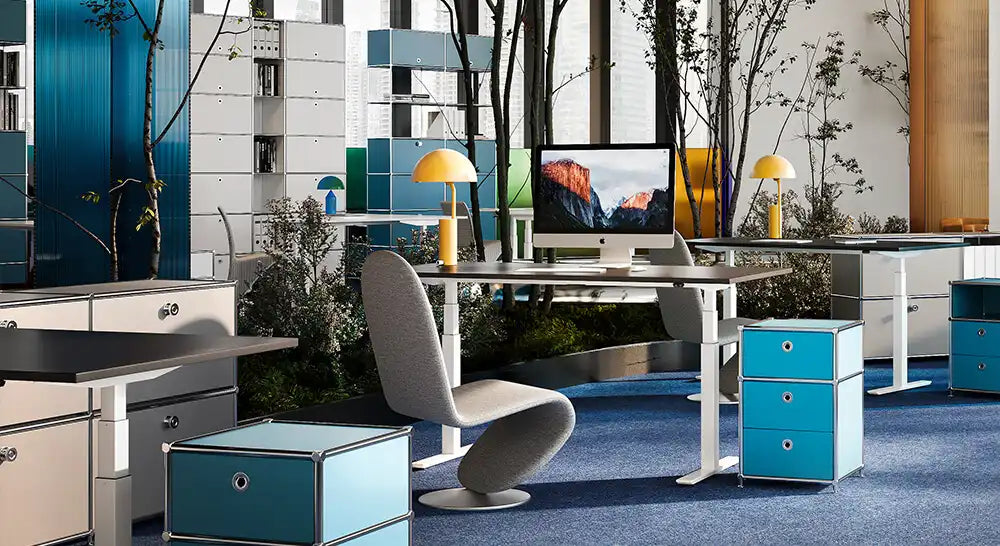
When it comes to office and interior design, there are many variables to consider. How big should your office be? What kind of layout is best for your team? How can you make the most of your space? These are all important questions that are difficult to answer on your own. That's where our guide comes in! In this guide, you'll learn everything you need to know about planning and furnishing your office—from choosing the right location to designing your interior. We'll also give you some tips on how to stay organized and productive in your new office. Whether you're just starting out or looking for ways to improve your current setup, this guide is for you!
Office Planning Guide: Why should you pay so much attention to office planning?

A well-planned office can improve productivity and employee satisfaction, while a poorly designed office can lead to frustration and low morale. Enjoyment at work is important for a company's culture. Office space can be among a company's most expensive overhead costs, so it makes sense to invest time and effort in ensuring it is efficient and effective. After all, changing office layouts can be costly and time-consuming. Taking the time to carefully plan your office space can help you avoid many potential problems from the outset.
What points are particularly important when planning the interior design?

A very important step, which should be taken at the very beginning of planning new office space, is the needs analysis . The size and type of company play a role in determining the specific requirements for the premises.
How many employees will work in the office? What kind of work will they do? What form of collaboration do they prefer? What kind of work atmosphere are you aiming for?
To ensure that the office space meets the company's needs, it is important to consult with employees, customers, and other stakeholders. This way, all specific requirements that need to be considered during the planning phase can be identified.
Only by understanding and addressing all needs can you create work environments that are both functional and stylish, as well as inspiring. This article outlines seven avoidable mistakes in office planning .
The perfect location
Where should the office be located? Various aspects are important when choosing the optimal location. Your needs analysis will provide you with important answers to these questions as well.
Office complexes or business centers offer a wide range of facilities and services that can significantly simplify setting up a new office. These include meeting and conference rooms, business support services, mail and courier services, and even on-site childcare. Many office complexes also offer attractive amenities such as gyms, restaurants, and cafes. When choosing a location for a new office, it is important to consider the needs of the company and its employees. For example, companies that rely heavily on client visits should choose an office with good visibility, convenient access to public transportation, and ample on-site parking. By carefully considering the company's needs, it is possible to find an office complex that offers the perfect blend of facilities and services.
Fundamentals of interior design

The larger the office you need to plan, the more complex the task becomes. Since professional office planning can quickly become expensive, we explain the process step by step. Professional office planners work with three concepts:
- The office concept
- The workplace concept
- The spatial concept
Definition: Office concept
The office concept addresses the question of HOW work is done, whether at an individual workstation in a group office or in an open-plan office. Whether at a fixed workstation or a desk-sharing workstation.
Definition: Workplace concept
Workplace design focuses on the layout and equipment of individual workstations in terms of function and ergonomics. Different tasks often require different technical equipment and furnishings.
Definition: Spatial concept
The spatial concept focuses on the allocation and arrangement of different functional areas within the space. It defines WHERE work takes place, where meeting rooms, break rooms, etc., are located. A good spatial concept considers the requirements for undisturbed work, communication opportunities, and freedom of movement.
Office concepts and their special features
In today's business world, the competition for top talent is fierce. To attract and retain top performers, companies are increasingly focusing on creating modern, comfortable, and stylish office spaces.
The office of the future will be designed to foster collaboration and creativity, with numerous open-plan workspaces, natural light, and innovative technologies. It will not only provide a pleasant and productive work environment but will also be highly sustainable, featuring energy-efficient buildings and green spaces. As companies strive to stay ahead of the competition, the office of the future will become increasingly important.
-
The private office was the classic example of the traditional office concept.
Since it is not well-suited for teamwork, it is now primarily found only in public areas where privacy must be guaranteed, or as an executive office. Today, most work is done in team or group offices , where several colleagues share a workspace. -
In an open-plan office, all workstations are arranged in one large area.
The advantage of open-plan offices is the small space requirement per workstation and the ease of communication between employees. However, a high noise level makes it difficult to concentrate. Open-plan offices are therefore particularly suitable where employees work closely together. -
The combined office design focuses on a deliberate mix of proximity and opportunities for retreat.
Meeting rooms, lounges, and kitchenettes are places for communication. On the other hand, employees also have access to quiet spaces for focused work. -
The open space concept is a modern evolution of the open-plan office.
The workspace is divided into different functional areas. There are fixed and flexible workstations, as well as numerous communal areas such as lounges with sofas, a coffee kitchen with standing tables, conference rooms, and relaxation areas. The open-plan concept fosters creativity, communication, and collaboration in everyday office life.
Designing workplaces correctly
Now that you have decided which office concept you want to use in your company,
In the next step, define the workplace concept . How should the individual workstations be designed and equipped in terms of function and ergonomics?
Creating a comfortable and ergonomic environment for employees is paramount when designing workplaces. The arrangement of office furniture should allow for ample freedom of movement, and all items should be easily accessible. Furthermore, the workstation should be designed to promote good posture and prevent strain on muscles and joints.
Make use of daylight , as it is very important for fatigue-free work.
Do you have a long window front? Ideally, the desks should be positioned at a 90-degree angle to it.
Plan for desks facing each other . Nobody likes sitting with their colleagues' backs to them. In teamwork, this facilitates communication and minimizes walking distances overall.
planning computer workstations

Working at a computer screen often leads to tension, neck or headaches, and burning eyes. For this reason, ergonomics at the computer workstation is particularly important.
Computer workstations should be designed so that the user can assume a comfortable sitting position and has easy access to the keyboard, mouse, and monitor. The ideal computer workstation is an ergonomically designed workspace tailored to the user's needs. The following factors should be considered when planning a computer workstation:
- The monitor should be at eye level. This prevents neck strain.
- The keyboard and mouse should be positioned so that the user's arms are at a 90-degree angle. This reduces strain on the wrists.
- The chair should provide good back support and allow the feet to rest flat on the floor.
As the largest accident insurer in Switzerland, SUVA is particularly committed to prevention.
Suva offers extensive information material and courses on the topic of ergonomics at the computer workstation.
Link to SUVA online presentation:
https://www.suva.ch/de-CH/material/Dokumentationen/praesentation-bildschirmergonomie
or: Learn more about “ ergonomics in the workplace ” in our guide.
2D office planning
For initial, quick drafts, the simple 2D version using the floor plan is recommended. A simple floor plan will help you find the best use of space.
The best tool for this is a floor plan at a scale of 1:100 . In a floor plan at a scale of 1 : 100 , a room is depicted as one hundred times smaller than it actually is. One centimeter in the floor plan therefore corresponds to 100 centimeters or one meter in reality.
Plan all relevant areas
Reception & waiting area, areas for office work, conference and meeting rooms, break area, coffee kitchen, technical and storage areas, social rooms – sanitary facilities, rest rooms, etc.
Divide the room into zones for focused work, zones for collaboration,
Create communication zones to foster a pleasant and efficient work environment. Separate the different zones with walls, room dividers, or low furniture. This will provide the necessary spatial boundaries.
3D Interior Designer
Following the initial 2D planning, 3D room planning should be carried out. This is particularly recommended for large rooms, as it is the only way to get a realistic picture of the space.
Gain clarity. Depending on how much energy, time and budget you have available, you can do this 3D planning yourself or have it done for you.
Online 3D interior design planner
There are various free 3D room planners from different providers for Mac or PC. They all work very similarly. First, you need to create a floor plan . There are usually templates available for this. Then you adjust this floor plan to the size of your office space, add walls, doors, and windows, and choose wall and floor colors. After that, you can begin planning the layout of the individual rooms.
The problem with free software, however, is that you usually can't plan with the office furniture you actually want, but only have a limited selection available. If you're completely unfamiliar with such software, this task can become quite challenging.
Interior designers from office furniture manufacturers
Some furniture manufacturers use their own planning tools, which customers can download for free, or offer a free planning service. Such a free office planning proposal can save you a lot of time. The more detailed your briefing can be, the better.
Specialized planning offices
Are you planning a very large-scale project? Specialized planning offices can create detailed concepts for you, right up to complete documentation for tenders. However, this comprehensive service can quickly become very expensive.
Alternatively, you can have your office planned by our experts free of charge and without obligation .
How do I plan a pleasant atmosphere for the employees?

We have already discussed the most important points:
- The spatial design and division into different zones effectively supports work tasks and work processes.
- The design and furnishing of workplaces so that employees feel comfortable, are motivated and can work ergonomically.
- In addition, good lighting conditions and the elimination of unnecessary acoustic disturbances are important.
- Meeting rooms for meetings in small or large groups
- Retreats for concentration, relaxation and social contacts
A completely different, but equally important point is the Office furniture and decoration
- What furniture should you use for your office setup?
- Do you want to add some color accents?
- Do you want decorations and plants to beautify your office?
Selecting the right office furniture
Choosing office furniture is perhaps the most important decision!
For this reason, we have created a dedicated blog to help you find the right office furniture. It addresses the following questions:
- What does ergonomics in the workplace mean?
- What makes a good office chair?
- How do I find the right desk?
- How do I find the right storage solution?
Here you can read how to... Setting up an office like a pro can.
Office planning checklist

Congratulations – on your successful Office planning It can begin. We have summarized the most important aspects for you again in this checklist.
- Needs analysis involving employees and customers
- Clarity about your office concept
- List of all areas that the office should include
- Selecting a suitable location
- Creation of workplace concepts
- Creation of a spatial concept
- Selection of office furniture
- Design and decoration of your office spaces
Conclusion
This concludes our series on office planning. We hope you found this blog helpful. If you have any questions or would like to learn more about office planning, please get in touch. We'd be happy to help you plan the perfect office for your business. Thank you!
Questions and answers about office planning
What is often forgotten during the planning phase?
Unfortunately, the positive effects of employee participation are often underestimated. Listening to all employees, repeatedly discussing the concepts throughout the development process, and considering their diverse needs can be very time-consuming. However, those who do so will ultimately be rewarded in the long run. Employee motivation will be significantly higher and more sustainable. In a new office that fails to consider employee needs and leaves no room for discussion during the planning phase, acceptance problems will only become apparent after the project is completed, jeopardizing the success of all your efforts and expenditures.
We have the 7 most common mistakes in office design summarized for you in a blog post.
How do I plan an executive office?
An executive office is the heart of many companies, where important decisions are made and business relationships are cultivated. To ensure you can work efficiently in your executive office, there are a few things to consider when furnishing it. The best tips for furnishing your executive office include comfortable and ergonomic furniture, a professional and calming color scheme, and a personal touch that makes you feel at home. You can learn more about this in our blog post “ Furnishing an Executive Office .”
What legal regulations exist in Switzerland regarding workplace design?
The State Secretariat for Economic Affairs (SECO) is responsible at the federal level for the protection of working conditions. All relevant legal regulations are clearly presented on its website. Ordinances 3 and 4 regulate the requirements for space and ergonomic design.
PDF “ Guide to Regulations 3 and 4 ”:
Share :
Guide: Setting up an office – How to furnish your office like a pro
Guide: Setting up a home office